Guest contribution – This article was written by Stefan Huser and Antun “Toni” Brcina from the Schweizer Finanzblog. You can find more information about the authors at the end of the article.
Many of our most expensive investment mistakes stem from behavioral patterns that ensured the survival of our ancestors. Mentally, we have largely remained hunters and gatherers. In the stock market and in retirement planning, however, they become an expensive trap—for professionals and amateurs alike.
Based on international research in behavioral finance, in this article we present the 15 cognitive biases that we consider to be particularly consequential for your investments and retirement planning. For each one, you will learn how it works, where you encounter it, and what you can specifically do against it.
In short
- Our brain was built for the savanna, not the stock market: Instincts such as the herd mentality or fear of loss systematically lead us astray when investing.
- The most effective protection consists of clear rules that you establish during calm times: a suitable investment strategy, broad diversification, and automation.
- When it comes to retirement planning, two cognitive errors weigh particularly heavily: We postpone decisions and cling to an investment strategy once chosen, even when it is no longer appropriate.
- Time has the greatest lever: Compound interest has little effect at first, but all the more later on. Anyone who starts early, invests regularly, stays the course, and keeps costs low lets it work for them.
What is Behavioral Finance?
In the textbook world of economics, the homo economicus acts: he processes all information without error and always makes rational decisions. Reality looks different. We overestimate some information, ignore other information, and make decisions from the gut.
This is precisely what behavioral finance examines: it combines psychology and financial science and explains why humans systematically deviate from reason when it comes to money. Its founders include the psychologists Daniel Kahneman and Amos Tversky—Kahneman received the Nobel Prize in Economics for this in 2002. Today, behavioral finance is an established part of international financial research; in 2017, the Nobel Prize went to another of its most important representatives, Richard Thaler.
What is a Bias?
A bias is a cognitive distortion: a thinking error that does not happen by chance, but rather systematically and predictably.
And if you think biases only affect fools, you are unfortunately mistaken: biases know no educational boundaries. Some can hit highly educated people even harder—more on that later.
The 15 Thinking Errors at a Glance
Out of over 100 known thinking errors, we have selected those that we consider particularly relevant for investing and retirement planning. We are counting backwards: the lower the number, the greater the damage that the thinking error can cause from our perspective.
| Rank | Thinking Error | In Short |
| 15 | Black Swan | The unthinkable happens more often than thought |
| 14 | Survivorship Bias | We only see the winners |
| 13 | Home Bias | Too much home in the portfolio |
| 12 | Confirmation Bias | Confirmation instead of truth |
| 11 | Action Bias | Doing something feels better than waiting |
| 10 | Information Bias | More news, worse decisions |
| 9 | Regression to the Mean | Yesterday’s winners are rarely tomorrow’s |
| 8 | Social Proof | Into the bubble with the herd |
| 7 | Hindsight Bias | It was bound to happen |
| 6 | Status Quo Bias | Set once, never looked at again |
| 5 | Loss Aversion | Losses hurt twice as much |
| 4 | Overconfidence Bias | Overconfidence comes before the fall |
| 3 | Sunk Cost Fallacy | Throwing good money after bad |
| 2 | Present Bias | Procrastination |
| 1 | Exponential Growth Bias | The underestimated compound interest |
No. 15: Black Swan – the unthinkable happens more often than thought
The term comes from author Nassim Taleb: A Black Swan is an event that nobody had on their radar and that entails enormous consequences. The thinking error consists in considering such events so far-fetched that we do not guard against them.
There are enough examples in this country as well. Swissair, once the pride of the nation, came to a standstill practically overnight in October 2001—a total loss for thousands of shareholders. In March 2023, UBS took over Credit Suisse in an emergency rescue—its shares became practically worthless. Anyone who invests in individual stocks experiences such crashes more often than you think. And in the 2020 corona crash, global stock markets fell by around a third within a few weeks.
How to outsmart it: You cannot predict Black Swans, but you can take the edge off them. Spread your wealth broadly, for example via a global index with thousands of companies, and keep a cool head during turbulence. A crash will then bring you book losses, but no single company collapse will cause a total loss.
No. 14: Survivorship Bias – we only see the winners
Rankings show the most successful funds of recent years. What you don’t see: the many funds that were quietly closed down due to lack of success or merged with others. They disappear from statistics—and from our memory. What remains is the impression that successful active funds are a dime a dozen.
The figures show the opposite. According to the SPIVA Europe Scorecard by S&P Dow Jones Indices (as of the end of 2025), over a ten-year period, 98% of actively managed global equity funds launched in Europe underperformed their benchmark index. Only about 62% of these funds even survived the ten years. And even among active funds with Swiss equities, 84% underperformed the index.
How to outsmart it: Don’t let yourself be blinded by success stories from the past two or three years. The decisive factor is long-term performance after costs compared to the matching index. Anyone who applies this yardstick honestly usually ends up with cost-effective index funds or ETFs. This also applies to Pillar 3a: providers like VIAC consistently rely on passive index funds there instead of active fund management.
No. 13: Home Bias – too much home in the portfolio
Many prefer their home market when investing: If you live in Switzerland, you like to invest in the SMI, Germans in the DAX. That feels familiar—you know the companies, read about them daily, and feel you have no currency risk.
The problem is concentration risk. In the SMI, Nestlé, Novartis, and Roche make up about half of the index; with UBS and ABB, it is about two-thirds. If one of these titles weakens, the whole index feels it. A global index like the MSCI ACWI, on the other hand, distributes your money across around 2,500 companies from nearly 50 countries—no single title carries heavy weight.
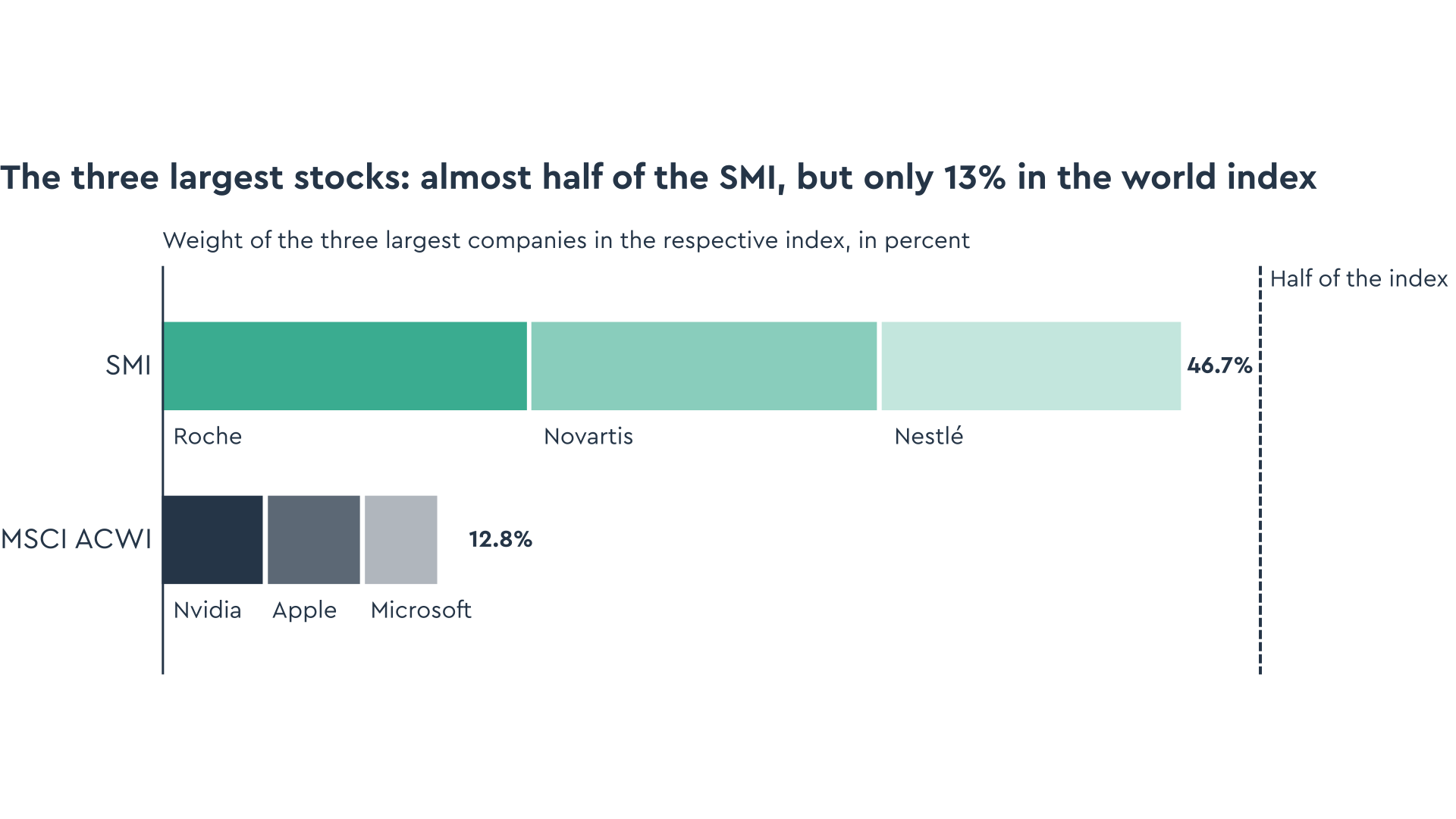
How to outsmart it: A certain Swiss share is acceptable if your expenses are in francs, because it cushions currency risk. However, consciously set an upper limit for yourself and invest the rest globally—ideally via a global index that covers developed and emerging markets. Diversification is the only “free lunch” in investing: less risk without sacrificing returns. In Pillar 3a, the Swiss share can be adjusted at will at VIAC using an individual strategy.
No. 12: Confirmation Bias – confirmation instead of truth
We tend to interpret new information in such a way that it matches our opinion. We blank out what contradicts it. Swiss author Rolf Dobelli calls this confirmation error the “father of all thinking errors.” The rule stated by British writer Aldous Huxley applies here: “Facts do not cease to exist because they are ignored.”
Suppose you are convinced that the stock market is a casino. Then every crash headline sticks in your memory while you overlook the long-term rising prices. Your conviction solidifies—and you may miss out on decades of returns. The same in retirement planning: Anyone who considers 3a money in the account to be the safest feels confirmed by every crash. It works the exact same way in reverse: Anyone who is enthusiastic about a stock only perceives positive news.
How to outsmart it: Write down your financial convictions and actively look for counterarguments. Even more effective: Ask the most critical person in your environment to tear apart your assumptions.
No. 11: Action Bias – doing something feels better than waiting
In unclear situations, we feel the urge to act, somehow. In the Stone Age, that made sense: Hesitating when something rustled in the bushes meant bad cards. In the stock market, it is often the other way around.
Researchers Brad Barber and Terrance Odean evaluated the accounts of over 60’000 US households (1991–1996). Result: The fifth with the most transactions achieved around 11.4% annually, whereas the market achieved 17.9%. Their study title says it all: “Trading Is Hazardous to Your Wealth.”
Stock market veteran André Kostolany summed it up: “Buy stocks, take sleeping pills, and don’t look at the papers anymore. After many years you will see: You are rich.” For broadly diversified index investments, we agree. With individual stocks, however, permanent sleep would be risky (see No. 15).
How to outsmart it: Define your investment strategy in writing while the markets are calm. Automate what can be automated, such as regular deposits. Spontaneous rebalancing out of the gut, on the other hand, costs fees and nerves—or as an old stock market wisdom says: “Back and forth empties pockets.”
No. 10: Information Bias – more news, worse decisions
We believe more information automatically leads to better decisions. Yet daily headlines bombard us: “SMI before trend reversal?”, “Chart signal points to correction”, “Buy now?”. Most of this is irrelevant for long-term investors, and much of it is pure speculation. Financial author Gerd Kommer mockingly calls such short-term forecasts “financial pornography”—each one is fodder for the action bias (No. 11).
How to outsmart it: Consciously reduce your consumption of financial news. Instead, invest the time you’ve gained in your financial education, for example by reading serious specialist literature or with our free guide Learn to invest – in 8 lessons. This gives you a stable foundation that no daily headline will shake.
No. 9: Regression to the Mean – yesterday’s winners are rarely tomorrow’s
After an extreme outlier, the next measurement is usually closer to the average again. Applied to the stock market: The fund or ETF with the best performance over the past three years is rarely the best over the next three.
Whoever ignores this engages in performance chasing: You chase yesterday’s returns. The result is buying in overheated markets at peak prices—a reliable loser formula on the stock market.
How to outsmart it: Set target weights for your asset classes and carry out rebalancing at least annually. This automatically sells what has done well and buys what has fallen behind—the exact opposite of performance chasing. At VIAC, rebalancing happens automatically—you don’t have to think about it yourself.
No. 8: Social Proof – into the bubble with the herd
When everyone runs in one direction, we run with them. In the savanna, that was smart: Anyone who hesitated when the group fled from a predator disappeared from the gene pool.
On the stock market, herd instinct, on the other hand, is a main driver of bubbles and crashes. Whether dot-com stocks around 2000 or crypto hypes: The more people in your circle talk about fast profits, the greater the fear of missing out—short FOMO, “Fear of Missing Out.” Anyone who enters then often buys shortly before the peak.
How to outsmart it: Become suspicious when an investment suddenly becomes a topic of conversation everywhere. Ask yourself: Would I buy this even if nobody were talking about it?
No. 7: Hindsight Bias – it was bound to happen
In retrospect, every development seems logical. The 2008 financial crisis, the 2020 corona crash—”that was foreseeable.” Except: Hardly anyone predicted these events in time and with precision. And the few who were right were often wrong before and after.
The hindsight bias is particularly persistent. Studies show: Even those who know about it fall for it almost just as often. It is dangerous because we draw a false conclusion from it: If the past was so predictable, the future must be too. That makes us overconfident.
How to outsmart it: Note down your market assessments with a date and read them again a year later. That is sobering—and healing. Even simpler: Dispense entirely with forecasts and invest according to fixed rules.
No. 6: Status Quo Bias – set once, never looked at again
We like to stick with the existing, even if there were better alternatives. Change means effort and the risk of making a mistake. Doing nothing feels safe, even though it is also a decision. At first glance, this is the opposite of the action bias (No. 11)—but there it’s about frantic reactions to price movements, here it’s about not reviewing the basic setting.
In Pillar 3a, this is clearly visible: According to a representative survey by YouGov commissioned by Baloise (2025), 52% of the Swiss population own a classic 3a account, but only 31% have a 3a solution with securities (some have both). Many open a 3a account at a young age and let their money sit there for decades, even though their investment horizon would allow a higher-yield strategy. Or they stick with an expensive retirement solution from their house bank for years because switching seems cumbersome and the advisor is always so friendly.
How to outsmart it: Review your strategy once a year: Does it still suit you, your investment horizon, and your risk tolerance? And use the status quo bias to your advantage: A standing order for Pillar 3a or a savings plan for your free assets invests regularly without you having to decide anew. That too is a status quo—but one that works for you.
No. 5: Loss Aversion – losses hurt twice as much
Kahneman and Tversky showed: A loss hurts us about twice as much as an equally large gain pleases us. A minus of 1’000 francs therefore feels as heavy as a plus of 2’000 francs.
This has two typical consequences. First, many panic-sell during a crash and turn book losses into real losses. Second, they avoid stocks entirely and leave their money in the account, even in Pillar 3a with its often decades-long investment horizon. Or they wait years on the sidelines for the perfect entry time—out of fear of buying shortly before a crash. However, this time cannot be predicted.
How to outsmart it: Choose an equity quota that fits your risk capacity and risk appetite. Risk capacity means: How long can you leave the money invested? In Pillar 3a, that is often decades—more than enough time to sit out even deep crashes. Risk appetite means: Can you still sleep peacefully if your equity share loses 40%? If either doesn’t fit, reduce the equity quota. If the fear of the wrong timing paralyzes you, enter in stages—that is still better than waiting for years.
No. 4: Overconfidence Bias – overconfidence comes before the fall
We systematically overestimate our knowledge and forecasting ability. Especially after initial successes: At the end of the 1990s, many thought they were brilliant stock-pickers because their internet stocks were rising. In truth, the whole market was simply rising—until the dot-com bubble burst.
Experts are not immune either. Psychologist Philip Tetlock evaluated thousands of forecasts from politics and business over years. Their hit rate was barely better than chance—and of all people, the best-known heads were often the most wide of the mark.
How to outsmart it: Approach forecasts, your own as well as those of pros, with healthy skepticism. If you invest long-term, you actually only need two assumptions: The global economy will continue to grow long-term, and companies will generate profits in the process. If you share both, much speaks for a broadly diversified stock portfolio.
No. 3: Sunk Cost Fallacy – throwing good money after bad
Sunk costs are expenses that are irrevocably gone. Nevertheless, we let them guide us in new decisions. “Now I’ve already paid so much, now I’ll see this through.”
Two examples: You have been invested in an expensive, actively managed fund for years. It significantly lags behind the benchmark index, but switching feels like admitting a mistake. So you stay—and continue to pay high fees year after year.
Sunk costs can have an even stronger effect on 3a insurance solutions that combine saving and risk protection: Because a significant portion of the premiums flows into closing and administrative costs, the surrender value is often well below the deposits. Anyone who switches realizes this loss—but much of it was incurred long ago.
How to outsmart it: Consider past wrong decisions as tuition fees and ask yourself: Would I buy in again today? The crucial factor is the overall package of costs, offering, and service. If it no longer convinces, switch—true to the motto “Better an end with horror than a horror without end.”
No. 2: Present Bias – procrastination
We know we should provide for old age. Nevertheless, we postpone it—because saving hurts today, the benefit only comes in decades. Research speaks of present bias. That’s why diets start tomorrow—and retirement provision next year.
The good news: You can outsmart yourself. In the “Save More Tomorrow” program by behavioral economists Richard Thaler and Shlomo Benartzi, employees arranged in advance to save part of future wage increases. That didn’t hurt today—and afterwards inertia (status quo bias, No. 6) ensured that most stuck with it. Their savings rate rose from 3.5% to 13.6% within a good three years.
How to outsmart it: Take the decision away from your future self. Set up a standing order that is triggered shortly after receiving your salary, instead of wondering in December whether it’s still enough. And increase it with every wage increase. At VIAC, investing starts with the very first franc—so there’s no reason to wait for a larger amount.
No. 1: Exponential Growth Bias – the underestimated compound interest
Rank number 1 goes to a thinking error that appears inconspicuous. Our brain thinks linearly—a legacy from the Stone Age: Whoever collected berries for twice as long had roughly twice as many in the basket. We systematically underestimate compound interest, however—yet it acts like a snowball that grows faster and faster as it rolls.
The tricky part: At the beginning, not much happens. Many give up too early because the effect hasn’t unfolded yet—consumption beckons, and it doesn’t seem to be worth it after all. The effect becomes more tangible with the Rule of 72: 72 divided by the annual return yields roughly the years until your money doubles. At 6%, that’s about 12 years. A lump sum of 100’000 francs thus turns into about 200’000 francs after 12 years (+100’000), 400’000 after another 12 years (+200’000), and 800’000 francs after another 12 years (+400’000). Equal time periods—but twice as much growth every time.
It becomes even more impressive with regular contributions, such as into Pillar 3a with 7,258 francs annually (2026 maximum amount for employees). The light bars show the same with 1.5 percentage points higher costs:
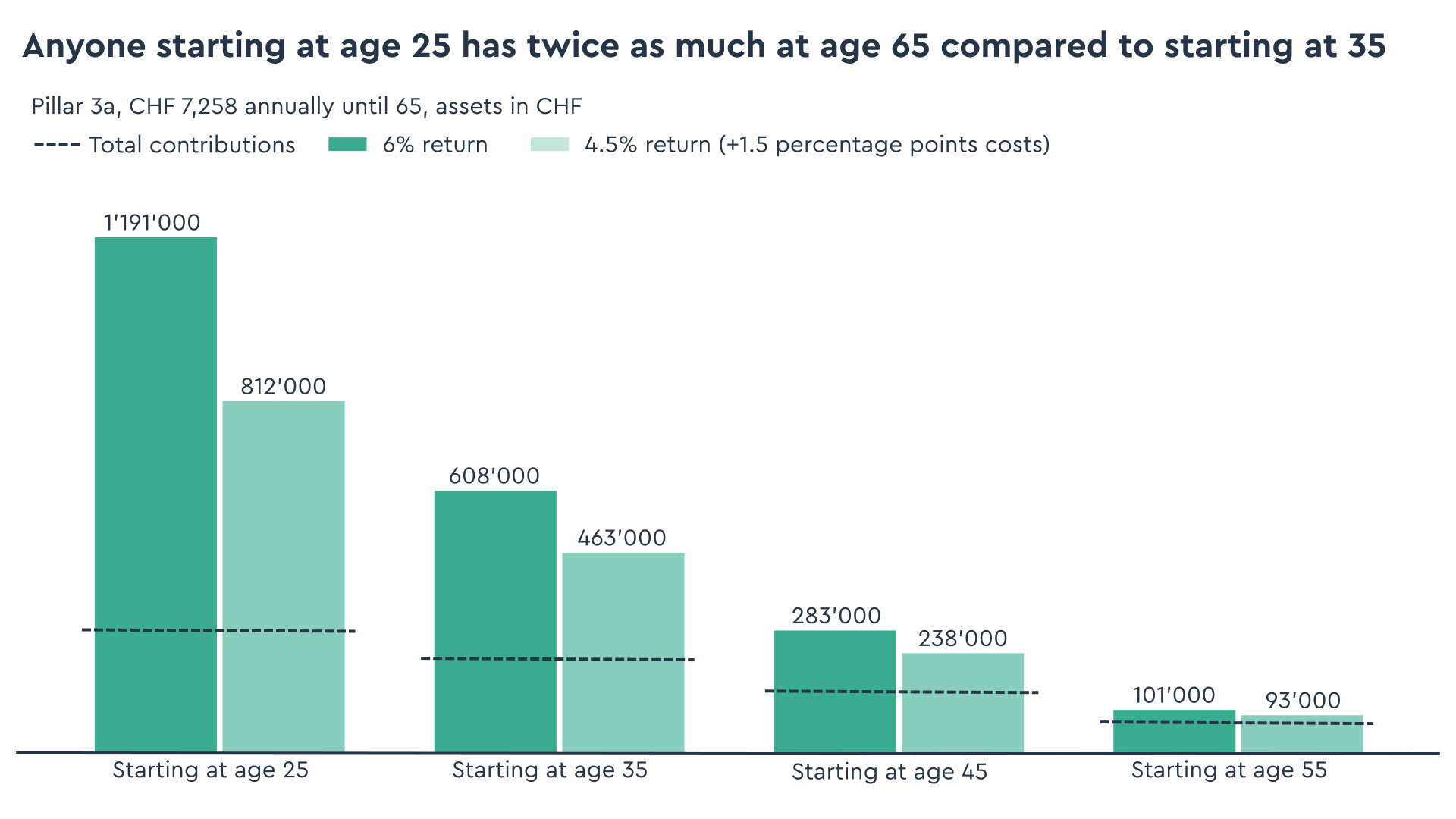
7,258 francs annually (maximum amount Pillar 3a 2026 for employees, BSV), deposit at the beginning of each year until 65; nominal, without taxes and inflation. Amounts in CHF, rounded to 1’000. The dashed line shows the deposited amount.
Starting ten years later means: a good 72’000 francs less deposited, but around 580’000 francs less wealth. And compound interest also works against you—in terms of costs: Just 1.5 percentage points more fees per year cost almost 380’000 francs when starting at age 25. And the savings rate acts directly: Whoever deposits half as much ends up with half as much.
How to outsmart it: Do not rely on your gut feeling for growth rates, but calculate it out. And use the three control levers that you hold in your hand: start early (see No. 2), as high a savings rate as possible, and low costs.
Conclusion: Rules beat instincts
You won’t get rid of your Stone Age brain—but you can set guardrails for it. Almost all 15 thinking errors can be mitigated with the same means: a strategy laid down in writing that fits your risk profile, broad diversification, low costs, and as much automation as possible.
Whoever defines these rules in calm times no longer has to decide in stormy ones. And whoever starts early lets time work for them instead of against them.
Ask yourself honestly which of these psychological pitfalls you have already fallen for—that is human. The decisive thing is to learn from it.
Further Reading
- Kahneman, Daniel: Thinking, Fast and Slow (2012) – the standard work on cognitive distortions, demanding but rewarding.
- Dobelli, Rolf: The Art of Thinking Clearly (2011) – entertaining introduction to over 50 thinking errors, also beyond the financial world.
- Housel, Morgan: The Psychology of Money (2021) – 20 short stories on why we act the way we do with money.
- Kommer, Gerd: Souverän investieren mit Indexfonds und ETFs (6th edition) – the scientific foundation for a rule-based buy-and-hold approach.
About the authors

Stefan Huser and Antun “Toni” Brcina run the Schweizer Finanzblog, an independent platform for long-term, science-based investing in Switzerland. Their focus: passive investing with ETFs, low costs, and retirement planning without jargon.
This article is a guest contribution as part of a cooperation with VIAC and does not constitute investment advice.