Key points at a glance
- Part-time work can lead to significant pension gaps: Working less means earning less and therefore paying less into the 1st and 2nd pillars.
- The pension fund can be a stumbling block: The fixed coordination amount in the 2nd pillar is not automatically adjusted to your part-time employment level. As a result, a much smaller share of your income may be insured through your pension fund.
- Pillar 3a can help close the gap: Private pension provision is one of the most important tools for part-time workers to build up additional retirement savings while also benefiting from tax deductions.
Why does part-time work lead to a pension gap?
Switzerland’s pension system is based on the three-pillar system. If you work full-time throughout your career, you can generally expect to receive around 60% of your final salary from the 1st and 2nd pillars in retirement. However, as a rule of thumb, you need around 80% of your previous income to maintain your accustomed standard of living after retirement. The resulting 20% gap is the classic pension gap. It can be partly closed through additional private pension provision, with Pillar 3a playing an important role. If you work part-time for many years or even throughout your entire career, you pay significantly less into the 1st and 2nd pillars. This can make the existing pension gap considerably larger. So, what exactly does part-time work mean for each pillar?
How does part-time work affect OASI (AHV; first pillar)?
In order to receive the maximum OASI pension of CHF 2’520 per month in retirement (as of 2026), two conditions must be met:
- Complete contribution period: You must have paid OASI contributions without interruption for 44 years, from the age of 21 until your retirement age.
- Average income: You need an average annual income of around CHF 90’720 (as of 2026).
People who work part-time for many years or permanently often do not reach this average income. Their OASI pension is therefore reduced proportionally according to the so-called scale 44 (page 18). The 1st pillar is nevertheless more generous than the 2nd pillar. If you work part-time but pay OASI contributions without interruption for all 44 years, you will still receive at least the full minimum pension of CHF 1’260 per month (as of 2026). There are also two factors that can cushion the impact of part-time work on your OASI pension:
- Education credits: If you look after children, OASI grants you education credits. These are taken into account when your OASI pension is calculated and can therefore increase your pension.
- Care credits: You can also receive credits for caring for relatives. These are not granted automatically. You must apply for them every year at the cantonal compensation office in the canton where the person you care for lives.
Overall, part-time work will generally result in a lower OASI pension. However, the minimum pension and possible credits mean that the impact is often less significant than with the 2nd pillar.
How does part-time work affect the pension
fund (2nd pillar)?
While the OASI (1st pillar) is designed to cover basic living costs, the pension fund (2nd pillar) is intended to help you maintain your accustomed standard of living after retirement.However, not everyone is automatically insured through a pension fund. The entry threshold is currently set at CHF 22’680 per year (as of 2026). If your annual salary from an employer is less than this amount, you are not automatically insured through a pension fund.
Even if you exceed this threshold, not all of your salary is necessarily insured. This is where the coordination amount comes into play. Currently, it amounts to CHF 26’460 (as of 2026) and is deducted from your gross annual salary. The idea is simple: the pension fund only needs to cover the part of your salary not already covered by the OASI (1st pillar). This prevents the same part of your salary from being insured twice.
However, for part-time workers, this fixed coordination amount can become problematic. It is not automatically adjusted to reflect your level of employment. Take Anna, for example. She is a qualified nurse and earns CHF 80’000 a year working full-time. After the birth of her first child, she reduced her hours to 50%, earning CHF 40’000. Although her salary has been cut in half, the coordination amount of CHF 26’460 remains unchanged. When working at 100%, CHF 53’540 of Anna’s salary is insured through her pension fund. At 50%, however, only CHF 13’540 is insured. Therefore, her salary falls by 50%, while her insured salary falls by around 75%.
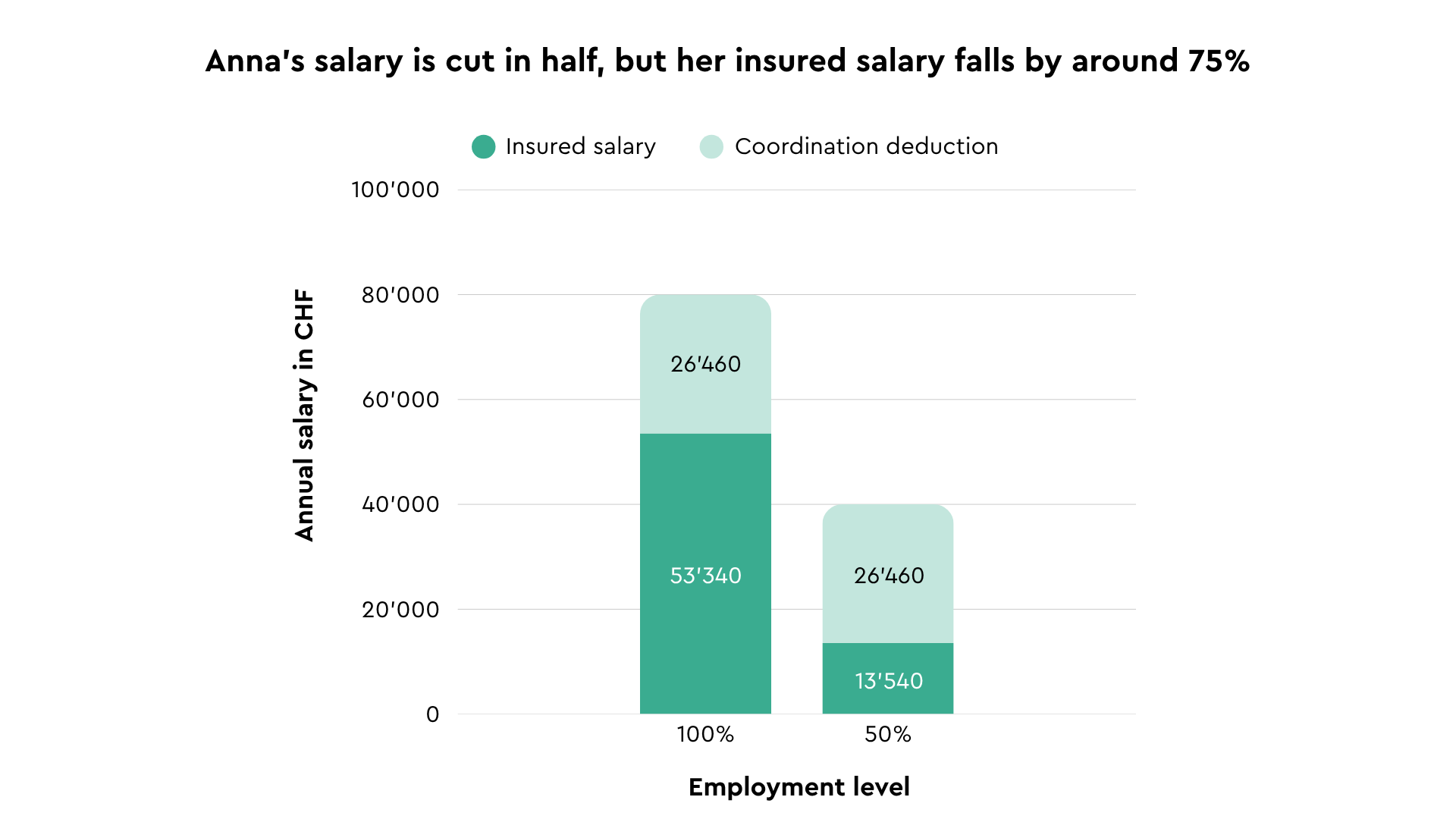
This means that Anna will build up significantly less retirement capital in her pension fund over the years. However, depending on your situation, there are ways to reduce the impact of part-time work on your second pillar. These three points should be checked:
Tips for part-time workers:
- Adjust the coordination amount: Some pension funds allow you to adjust the coordination amount according to your actual level of employment. Check with your employer or HR department to see if this is possible.
- Combine several jobs: If you work for several employers and are insured through pension funds with each of them, the coordination amount may be applied separately to each employment relationship. Check whether you can insure your incomes together through a single pension fund.
- Take out voluntary insurance: If you earn less than the entry threshold with each employer but your combined income exceeds it, you may be able to take out voluntary insurance in the 2nd pillar under certain conditions. Check with one of your employers’ pension funds or the Substitute Occupational Benefit Institution to see if this is possible.
What role does Pillar 3a play for part-time workers?
If working part-time creates gaps in your 1st and 2nd pillars, private pension provision becomes even more important. With Pillar 3a, you can build up additional retirement savings and close some of your pension gap yourself. In principle, anyone who pays OASI contributions can pay into Pillar 3a. How much you can pay in depends on whether or not you are affiliated with a pension fund.
- With a pension fund: The maximum amount is CHF 7’258 per year (as of 2026).
- Without a pension fund: You can pay in up to 20% of your net earned income, up to a maximum of CHF 36’288 per year (as of 2026). This applies to self-employed people without a pension fund, for example, and to employees whose income is below the entry threshold for the 2nd pillar.
You don’t have to make the maximum contribution. If you have a lower income from part-time work, for example, you can adjust your contributions to suit your budget.
How part-time workers can make the most of Pillar 3a:
- Start early: As part-time workers accumulate less retirement capital, the effect of compound interest can be particularly beneficial over time, depending on the investment strategy. Every franc you invest early has more time to work for you.
- Make every franc count: Pay in as much as your budget allows. This will help you to build up your retirement savings and give you a tax deduction on the amount paid into Pillar 3a.
- Invest in securities: Your Pillar 3a assets are usually invested for decades. Depending on your personal situation and risk tolerance, therefore, investing in securities with a high equity allocation can make sense. In the long term, this offers higher return potential than a traditional Pillar 3a savings account and enables you to benefit more from the effect of compound interest.
Let’s return to Anna. To reduce the pension gap caused by her part-time work, she pays CHF 250 per month into her Pillar 3a for 35 years. In total, she contributes CHF 105’000 herself. With her Pillar 3a, Anna can choose between different investment strategies. These differ, among other things, in their equity allocation. Depending on the strategy she chooses and how the financial markets perform, her assets can develop very differently. Let’s look at two scenarios. If she chooses a strategy containing 40% equities with an assumed net return of 4% per year, her Pillar 3a assets would grow to around CHF 228’433. If she opted for a strategy with almost 100% equities and an assumed net return of 7% per year, her assets would grow to around CHF 450’264.
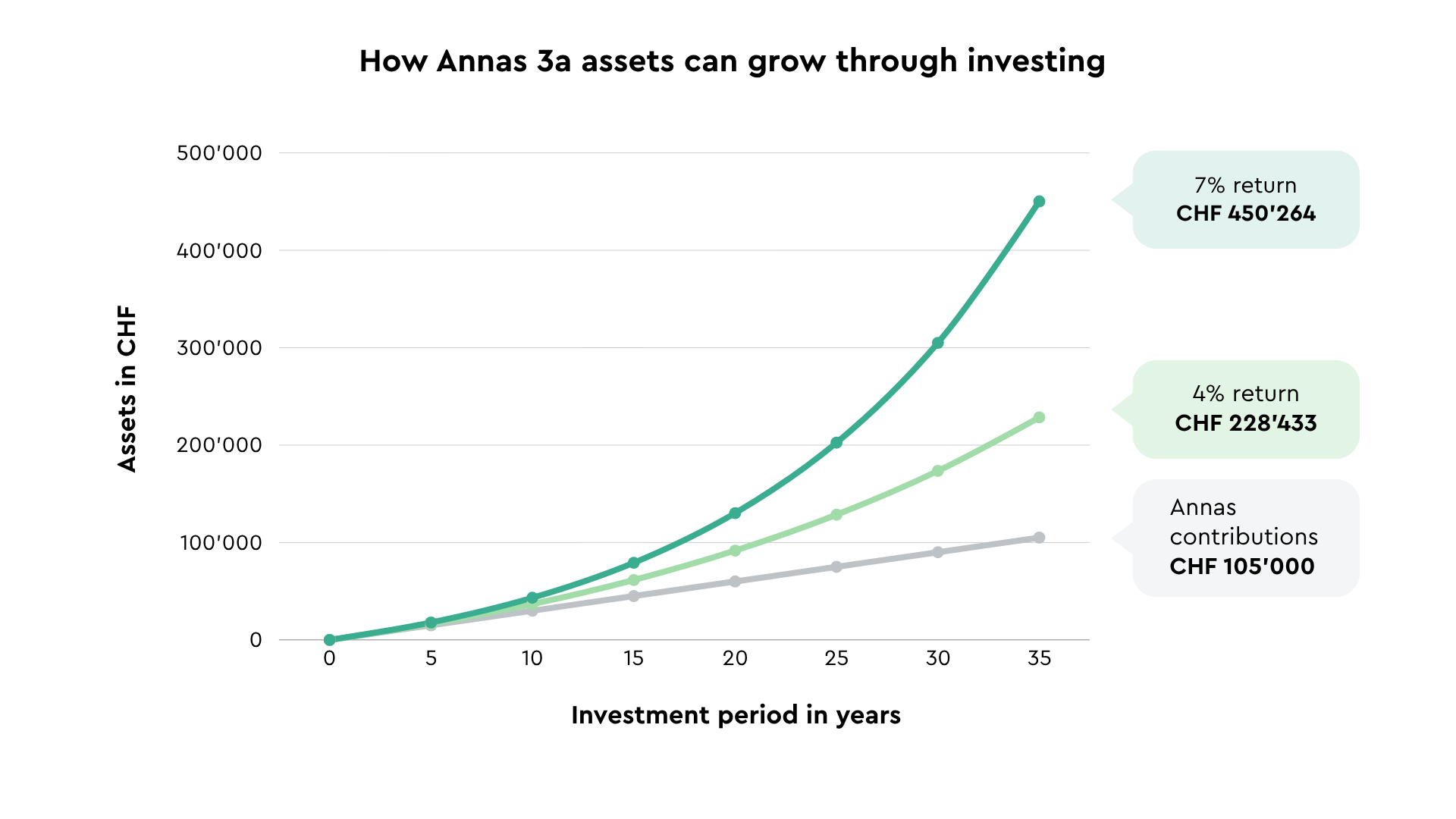
Assumption: Monthly contribution of CHF 250 over 35 years.
Assumed constant net return of 4% or 7% per year. Returns are not guaranteed.
These two scenarios demonstrate the significant impact that differences in returns can have over a long period of time. However, the time factor also matters: the earlier Anna starts paying in, the longer she can benefit from compound interest. Want to take control of your retirement provision like Anna and actively reduce your pension gap? Then open your Pillar 3a with award-winning VIAC – simply and conveniently.
Disclaimer
This article does not constitute retirement planning or financial advice. Each person’s retirement planning situation is unique and depends on various factors. If you have specific questions about your personal retirement planning, pension fund, or Pillar 3a, we recommend consulting a specialist or the relevant pension provider. Although VIAC has carefully researched the contents and information provided above, their accuracy and completeness cannot be guaranteed. Any liability is declined.