First: Pillar 3a providers were expensive. A securities solution with fees of nearly two percent—that eats up the tax advantage immediately. With the rise of app providers like VIAC, this argument has now been resolved. Today, you pay fees in the range of a few tenths of a percent and get a broadly diversified equity solution in return.
Second: Taxes are due when withdrawing 3a funds. These are often higher than the savings previously achieved upon contribution. Ergo: Pillar 3a is not worth it. I still hear and read this argument almost daily. And basically, it is true: the tax deduction upon payment is indeed often similar in size to the withdrawal tax at the end.
But the argument is only true at first glance, because Pillar 3a has more important financial benefits than just the tax deduction upon contribution.
Let me show you with an example.
Mira, 25 – the 3a option
Let’s take Mira, 25 years old, at the start of her professional life. Every year, she pays the maximum amount of 7’258 francs into Pillar 3a. She chooses a securities solution with a high proportion of equities and low fees—the choice of provider makes a big difference here, but more on that later. With a long-term equity return of 6 percent per year, her 3a assets grow over forty years to around 1.02 million francs.
At Mira’s marginal tax rate of 18 percent, she saves around 1’300 francs in taxes per contribution. Over forty years, this adds up to around 52’000 francs in tax savings on contributions. That’s a lot of money.
When the funds are withdrawn between the ages of 60 and 65, capital withdrawal tax applies. Mira staggers her withdrawal over five years, which pushes down the tax rate. The tax rate varies greatly from canton to canton. For this example, let’s assume an effective rate of just over five percent. Then she pays roughly 52’000 francs in withdrawal tax.
Exactly the same amount she previously saved on contributions. Her tax advantage from the contributions is thus completely gone upon withdrawal. On a net basis, Mira is left with around 964’000 francs in her account from her 1.02 million. If the tax argument were the only one, all the effort with 3a would indeed not have been worth it.
But this is precisely where the point comes in that most people overlook.
Tim, 25 – the private option
Let’s take a look at Tim, also 25 years old, who consistently invests privately. He doesn’t think much of Pillar 3a, opens an account with a low-cost online broker, and buys the same equity funds as Mira. For the calculation, we assume that Tim also achieves a return of 6 percent per year—so his investment strategy is identical.
The only difference lies in the tax treatment. Tim cannot deduct his contribution from his taxable income. If he wants to invest the same 7’258 francs per year as Mira, he must first pay tax on this as income. At a marginal tax rate of 18 percent, 1’306 francs go to the state—so Tim only has 5’952 francs per year left that he can actually invest.
Over forty years at 6 percent equity return—and 0.2 percent fees with the online broker, slightly lower than Mira’s in 3a—Tim’s private portfolio grows to around 740’000 francs. No withdrawal taxes apply, and Tim can withdraw the money at any time.
The difference is remarkable: Mira has 964’000 francs net, Tim has 740’000 francs. The advantage of Pillar 3a is around 220’000 francs—even though the tax savings on contribution were completely given back upon withdrawal. A difference of nearly a quarter of a million francs. For two people with the same savings rate, the same investment strategy, and the same return expectations.
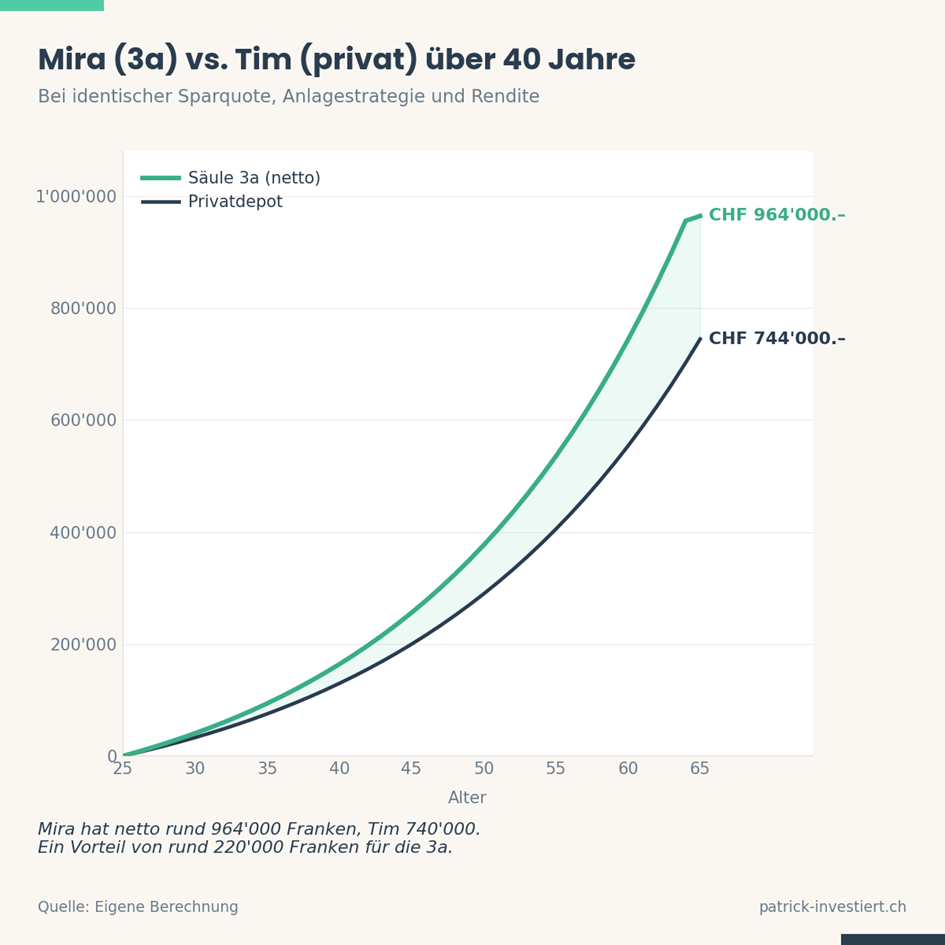
Mira’s 3a assets after withdrawal tax (964’000 francs) versus Tim’s private portfolio (740’000 francs) over 40 years.
How does this difference of 220’000 francs come about if the tax deduction and withdrawal tax offset each other?
Three advantages that add up significantly
First: no wealth tax on 3a capital. A private securities portfolio is added to your wealth year after year. The 3a account is not. At an average wealth tax rate of 0.2 percent, that sounds like little—but accumulated over forty years and with growing wealth, this results in a tax saving of around 21’000 francs for Mira compared to Tim.
Second: dividends are tax-free in Pillar 3a. The dividends generated annually by Tim’s ETF—realistically around 2.5 percent of invested assets—must be taxed as income. Mira’s 3a portfolio is exempt from this income tax on dividends. Over forty years, this advantage also sums up to around 44’000 francs.
Third, and this is the biggest chunk: the compound interest effect on the tax savings themselves. What does that mean? Mira saves 1’306 francs in taxes on every contribution. She can reinvest this amount herself instead of giving it to the state. Tim doesn’t have this option—he is missing the 1’306 francs per year right from the start. Over forty years at a 6 percent return, Mira’s annually reinvested tax savings grow to around 154’000 francs in additional wealth.
In other words: the taxes Mira doesn’t have to pay over the years thanks to 3a continue to work for her. With Tim, it’s different. Only the state benefits there.
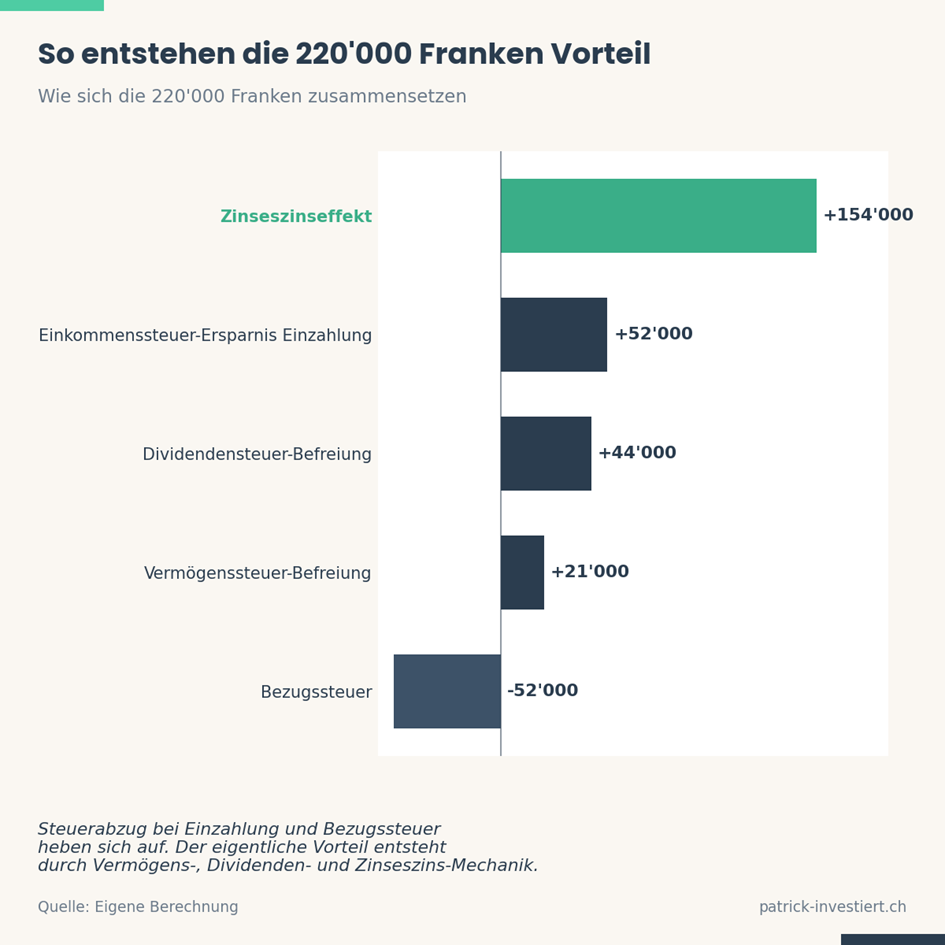
Three advantages build the 220’000-franc lead—the tax saving on contribution is completely offset by the withdrawal tax.
In total: wealth tax 21’000 plus dividend tax 44’000 plus compound interest effect 154’000 equal roughly 220’000 francs. Exactly the difference between Mira and Tim.
Note: the direct tax deduction on contributions does not appear in this breakdown at all—it goes away upon withdrawal. The advantage of Pillar 3a arises not from the classic tax deduction, but through the three other mechanisms running in the background.
“But with my salary, it’s not worth it”
So much for the ideal case: 25 years old, full maximum amount, forty-year horizon. What happens when life circumstances are different?
Let’s look at Lara, 35 years old, mother of two children, works 80 percent as a nurse, earning 55’000 francs a year. The maximum amount of 7’258 francs is out of reach for her, that’s clear. But she manages to set aside around 200 francs a month—resulting in 2’400 francs per year.
Lara pays these 2’400 francs per year into Pillar 3a. At her marginal tax rate of 13 percent, she saves around 300 francs in taxes per contribution. Over the next thirty years until retirement, her 3a assets grow to about 177’000 francs gross; after withdrawal tax of about 4.5 percent, around 169’000 francs remain.
And if she invested the same money privately like Tim instead? Then she would first have to pay 13 percent tax on the 2’400 francs—leaving her with just under 2’100 francs a year to invest. Over thirty years, that grows to around 145’000 francs. Difference: 24’000 francs advantage for 3a.
Sure, the effect isn’t as large as with Mira, but fundamentally the mechanics for Lara are the same—simply scaled with the savings amount and investment horizon. And with an additional 24’000 francs thanks to Pillar 3a, it’s still almost half a year’s salary.
Important: Lara does not have to pay in the maximum amount for 3a to be worth it for her.
“But I’m already too old”
The second life situation: Beat, 50 years old, earns 95’000 francs a year. He hasn’t consistently paid into Pillar 3a so far—a few years self-employed, a break in between, and somehow 3a always fell short. Now he does the math: “I only have fifteen years left until retirement. The whole effort isn’t worth it anymore.”
If Beat pays the maximum amount of 7’258 francs every year starting today, he will have 3a assets of around 142’000 francs gross at 65. For him, I deliberately calculate with a more balanced 50/50 investment strategy of equities (6 percent return) and bonds (2.2 percent return) because that suits his fifteen-year horizon. After withdrawal tax of 4.5 percent, around 136’000 francs remain in the account. Had he invested privately instead—i.e., 7’258 minus 25 percent marginal tax = 5’444 francs per year—his private portfolio would have grown to about 100’000 francs. Difference: well over 30’000 francs advantage for 3a.
Because Beat is older, the compound interest effect on invested tax savings plays a smaller role for him than for Mira or Lara. What works strongly for Beat instead: the direct tax deduction. At his marginal tax rate of 25 percent, he saves 1’800 francs in taxes every year per contribution. Over 15 years, this comes to around 27’000 francs in tax savings. Upon withdrawal, due to his relatively low assets in Pillar 3a, he pays relatively low taxes of around 6’000 francs.
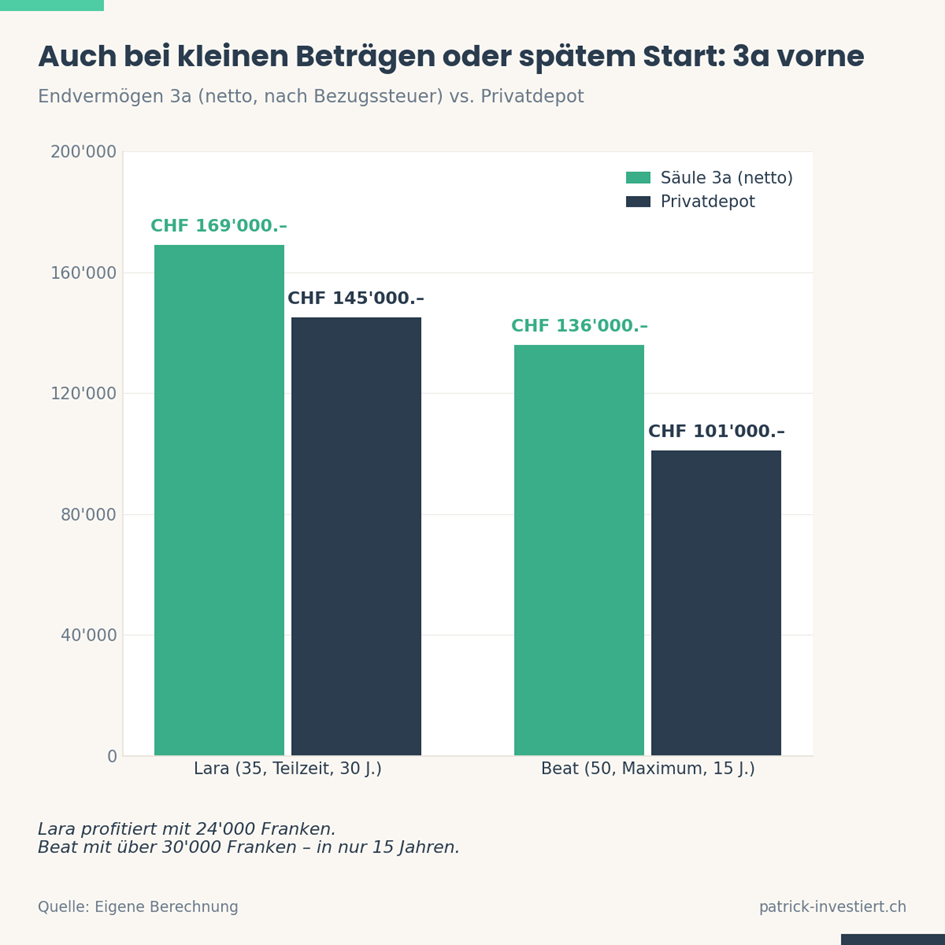
Even with small amounts or a late start: the 3a account comes out ahead in the end.
The mechanism is fundamentally always the same: Mira benefits primarily from the compound interest effect over forty years. Lara benefits to the extent of her smaller contribution, but proportionally the same. Beat benefits from the direct tax deduction, which is immediately noticeable, especially for middle and high incomes.
What about the withdrawal tax?
“But politicians want to raise the withdrawal tax,” I unfortunately hear from time to time. The short answer: the increase in withdrawal tax planned by the Federal Council has since been rejected by parliament. So everything stays as it was.
And even if it were to change at some point, you never know in politics… Holistically speaking, an increase wouldn’t be that bad. Especially those who stagger their withdrawal over five years currently pay effective tax rates in the magnitude of maybe three to six percent. Even if this rate were to rise noticeably—perhaps by one or two percentage points—the three other advantages would remain intact: no wealth tax, no dividend tax, compound interest effect on tax savings. Precisely what makes the actual difference for Mira, Lara, and Beat. A withdrawal tax higher by a few thousand francs does not negate these advantages; Mira’s advantage over Tim might then shrink from 220’000 to 210’000 francs.
What does this mean for you now?
How old are you, how high is your salary, how many years are ahead of you? Perhaps you recognize yourself in Mira, perhaps in Lara, perhaps in Beat—or somewhere in between. Basically, Pillar 3a is worthwhile for everyone.
However, only if you keep one important thing in mind:
Check the fees of your 3a solution! 3a only works as shown in the examples above if the money is actually invested cost-effectively. With classic 3a securities solutions at many banks or insurance companies, you quickly pay 1.5 percent or more in annual fees including product costs (be sure to ask!). Mira’s whole advantage would be gone.
Otherwise, the following applies:
Only pay into Pillar 3a what you won’t need in the next few years. It doesn’t necessarily have to be the maximum amount. 200 francs per month is fine too. You can always increase the amount later.
Choose a securities portfolio instead of a savings account solution. Many choose a 3a account solution with minimal interest, which usually doesn’t even offset inflation. Precisely because the money stays in Pillar 3a for a very long time, from a scientific point of view, there isn’t much arguing against a high equity allocation (and thus a securities portfolio solution).
The entire calculation of benefits in this article only works because of compound interest—and that can only be earned with equities.
About the author

Patrick Eugster completed his PhD in Finance at the University of Zurich in 2022. Since then, he has been teaching people how to invest – through videos, blogs, lectures, and much more. You can find his blog at www.patrick-investiert.ch.
Note: This article is a paid guest post. The content was independently researched and created by the author. VIAC had no influence on the editorial content, and this is not an advertisement for VIAC.