How much money will you need in retirement? And how do you ensure that you can maintain your usual standard of living after you retire? AHV (state pension) and your pension fund form the foundation of your retirement provision. However, depending on your income and personal situation, the money from these two sources may not be enough to cover all your previous expenses.
This is where Pillar 3a comes into play. It allows you to save for retirement on a voluntary basis, and the state supports your efforts with tax advantages. Thanks to a long investment horizon, Pillar 3a is ideal for investing in the stock market. How much you are allowed to pay in, when you can access your money, and which type of investment suits you best depends on various factors.
1. What is Pillar 3a?
Pillar 3a is the tied private pension scheme in Switzerland. You pay in money voluntarily, which is generally intended for your retirement provision. In return, you benefit from tax advantages: you can deduct your contributions from your taxable income. The state specifies how much you are allowed to pay in per year as an employee or as a self-employed person. This is known as the maximum amount. As an additional benefit, no wealth or income taxes are incurred during the term.
In return, you cannot withdraw the money at any time. A payout is only possible under certain legal conditions, for example upon retirement or for the purchase of owner-occupied residential property. You can find more on the topic of Pillar 3a payouts in Chapter 8.
In brief: Retirement provision in Switzerland – the three pillars
- Pillar 1 (AHV/IV): State pension provision. It secures the basic standard of living in retirement.
- Pillar 2 (Pension fund): Occupational pension provision. It provides employees with additional retirement benefits and risk coverage. It complements the AHV and, together with it, is intended to help maintain your accustomed standard of living. As a rule of thumb, the first two pillars can be expected to provide retirement benefits amounting to around 60% of your final salary. This is where the 3rd pillar comes into play.
- Pillar 3 (Pillar 3a): Private/voluntary pension provision. It helps you cover the remaining percentage, close potential pension gaps, and build up additional wealth.
You can find more details about the 3-pillar system in Switzerland in this article.
How much money you will receive from the AHV and pension fund later on depends on your income and your career history, among other things. Especially with part-time work, longer career breaks, or a high income, it is worthwhile to make additional private provision.
2. Why is Pillar 3a worth it?
Pillar 3a offers you several benefits at once. How much you benefit depends on how much you pay in, where you live, your salary, how long your money remains invested, and which solution you choose.
You save taxes
You can deduct contributions to Pillar 3a from your taxable income. As a result, you pay less income tax in the respective year.
How much you save depends on your income, place of residence, and your contribution. For clarification, below is an overview of tax savings for four different profiles (as of 2026):
| Profile | Basel | Zurich | Geneva |
| Single, CHF 85’000, maximum amount | 1’729 | 1’467 | 1’906 |
| Single, CHF 150’000, maximum amount | 2’174 | 2’205 | 2’459 |
| Married, CHF 120’000, maximum amount each | 3’870 | 2’534 | 3’213 |
| Married, CHF 250’000, maximum amount each | 4’929 | 4’989 | 5’519 |
In this short example, an age of 35, no children, and non-religious status were assumed for the calculation across all profiles.
You can calculate your personal tax savings using the tax calculator from the Federal Tax Administration. To enter the Pillar 3a deduction, click on ‘detailed calculation’.
You build wealth over the long term
With every contribution, your pension assets grow. If you invest your money in securities, you also have the opportunity to benefit from financial market developments.
The compound interest effect supports you here: returns generated from your invested capital remain invested and can earn returns themselves. Over many years, this can make a significant difference.
However, this does not happen in a straight line. Securities can lose value in the meantime, and a positive return is not guaranteed. You can find more on the topic of compound interest in Chapter 7.
You benefit from tax-free returns during the term
While your money remains in Pillar 3a, no wealth taxes are levied on the balance. Dividends, interest, and investment returns are also not taxed as income during this time.
Upon withdrawal, the assets are taxed separately from other income at a reduced rate. You can find more on the topic of taxes in Chapter 10.
Wondering whether Pillar 3a is worth it for you? Together with Patrick Eugster, we ran the numbers for two examples. You can find the article here.
3. How much are you allowed to contribute to Pillar 3a?
The federal government determines the maximum amount you can contribute to Pillar 3a each year and deduct from your taxes. This depends on whether you are affiliated with a pension fund.
Maximum amounts for 2027
| Category | Maximum amount per year |
| With pension fund | CHF 7’373 |
| Without pension fund | CHF 36’864 maximum 20% of net earned income |
You can find more on the topic of maximum contributions for 2027 in this article.
Why do maximum amounts change?
Contributions are not determined arbitrarily every year. They are aligned with the statutory threshold amounts of occupational pension provision, which the Federal Council reviews annually. If these rise, the maximum amounts for Pillar 3a may also change. This is why contribution limits sometimes remain unchanged for several years before being adjusted.
You don’t have to contribute the maximum amount
You decide for yourself how much you want to pay in. If your budget is tight or you want to save for other goals, you can also build provision with smaller amounts. You don’t need to max out the limit every year to benefit from the tax advantages of Pillar 3a. The main thing is that you do not contribute more than the maximum allowable amount.
Can I make retroactive Pillar 3a contributions for past years?
If you were not always able to pay in the maximum amount, there is good news for you: since 2025, you can make retroactive contributions to your Pillar 3a. However, specific requirements apply. These are the most important ones:
- The regulations only apply to pension gaps from 2025 onwards, meaning pension gaps that arose before 2025 cannot be closed.
- In the relevant year, you must have earned an income subject to AHV contributions.
- In the year you make the retroactive contribution, the ordinary maximum Pillar 3a amount must already have been paid in.
- Only one retroactive contribution per gap year is permitted.
- Only gaps that are no older than 10 years can still be closed.
- The amount of retroactive contributions is limited: in a single calendar year, no more than the maximum amount can be paid in to fill gaps.
- If the pension scheme member makes a retirement withdrawal, buy-ins/retroactive contributions are no longer permitted.
In this article you will find all information regarding Pillar 3a retroactive contributions.
4. Who is eligible to contribute to Pillar 3a?
In general, you are allowed to contribute to Pillar 3a if you earn an income subject to AHV contributions. This includes, for example:
- Employees with a salary subject to AHV contributions.
- Self-employed persons with earned income subject to AHV contributions.
- Persons receiving unemployment benefits who satisfy the corresponding requirements.
- Cross-border commuters, provided the statutory conditions are met. You can find more on this in this article as well as in this article.
5. Insurance solution or bank solution?
When opening a Pillar 3a account, you can generally choose between an insurance solution and a bank solution. Both have distinct characteristics. Which one is better suited for you depends on whether your main goal is to save and invest or to simultaneously cover certain risks.
| Feature | Insurance solution | Bank solution |
| Purpose | Combines retirement savings with insurance coverage. | Focus on saving and investing. The compound interest effect is fully leveraged. |
| Flexibility | Depending on the contract, very restricted (mandatory contributions/savings obligations). Changes or early termination can lead to financial disadvantages. | Contributions and investment strategy can generally be adjusted flexibly and free of charge. |
| Costs | Costs can be complex and composed of multiple components. | Costs vary by provider and are often structured more transparently than with insurance companies. Digital providers like VIAC are far cheaper than solutions from traditional banks and insurance companies. |
| Coverage | Depending on the contract, benefits in the event of death or disability are included. | No disability and/or death coverage. The exception is VIAC, thanks to the free VIAC Life Basic protection, which can be extended very cost-effectively with Life Plus. |
| In case of early cancellation | If you cancel your insurance policy, you may receive significantly less money back than you paid in premiums. | A fee-free transfer is generally possible. |
With an insurance solution, it pays to read the contract carefully before signing. Pay particular attention to what fees and commissions apply, how high the guaranteed benefits are, and what happens in the event of an early cancellation. Depending on the contract, cancellation can cause financial losses.
With a bank solution, you should also compare costs carefully. Not every bank solution is equally affordable. Pay attention to total costs, including fees for investment products (product costs, TER). A low management fee alone does not tell the whole story: besides management and product fees, there are often other costs that add up. If terms like brokerage fees, retrocessions, or foreign currency costs are unfamiliar to you, this article will help you navigate the fee jungle.
Keeping savings and insurance coverage separate allows you to choose and adjust both areas independently. At VIAC, the focus is on a digital and cost-effective retirement solution. Did you know? As a VIAC pension client, you receive VIAC Life Basic, free protection against disability or death. If you require additional coverage, VIAC Life Plus offers an attractive solution.
You can find more information about the benefits of a Pillar 3a with a bank compared to an insurance policy in this article.
6. Account or securities: Do you want to invest your 3a money?
When you opt for a bank solution, the next question arises: Should your money sit in an interest-bearing retirement account or be invested in securities?
The account solution
With an account solution, your balance earns interest. The account balance does not fluctuate based on stock market prices. However, the return is usually relatively low. This can make sense if you need your money soon or do not want to bear market fluctuations.
Over a long investment horizon, however, there is a major drawback: if the interest rate is lower than inflation, the purchasing power of your balance decreases.
Inflation: A simplified example
Suppose you have CHF 10’000 in an account that pays no interest. Inflation remains steady at 2% per year.
After 10 years, the purchasing power of your original CHF 10’000 decreases by nearly 18% to approx. CHF 8,200. This means that after 10 years, you can buy significantly less with your CHF 10’000 than before.
A rule of thumb for Switzerland states that the purchasing power of your money halves roughly every 40 years.
Using an inflation calculator, you can easily calculate for yourself how much inflation eats away from your money.
7. When should you start investing?
If you want to build wealth over the long term, time plays a major role. The earlier you start investing, the longer your returns can generate returns of their own. This is known as the compound interest effect.
The power of compound interest is demonstrated by a simplified example:
| Investment period | Final amount | Return compared to previous period |
| 10 years | Around CHF 8’144 | CHF 3’144 |
| 20 years | Around CHF 13’266 | CHF 5’122 |
| 30 years | Around CHF 21’610 | CHF 8’344 |
Assuming you invest a one-off amount of CHF 5’000 and achieve an average long-term return of 5% per year. Fees, taxes, and inflation are not taken into account in this calculation.
You can see that money grows not just through the original deposit. Over time, the returns already generated also contribute to further growth. Important: This calculation is a model calculation, not a return forecast. There are no guaranteed returns on the financial markets. You can easily recalculate this using your own amounts and investment duration with an interest calculator.
The following example shows what a longer investment horizon really makes possible:
We compare two people. They invested the same amount of money over a period of 30 years. We assume a steady return of 5% per year. The only difference is when they started investing.
- Person A: Invests CHF 200 per month or CHF 2’400 per year since 2026
- Person B: Invests CHF 300 per month or CHF 3’600 per year since 2036
In total, they have each invested CHF 72’000 after 30 years.
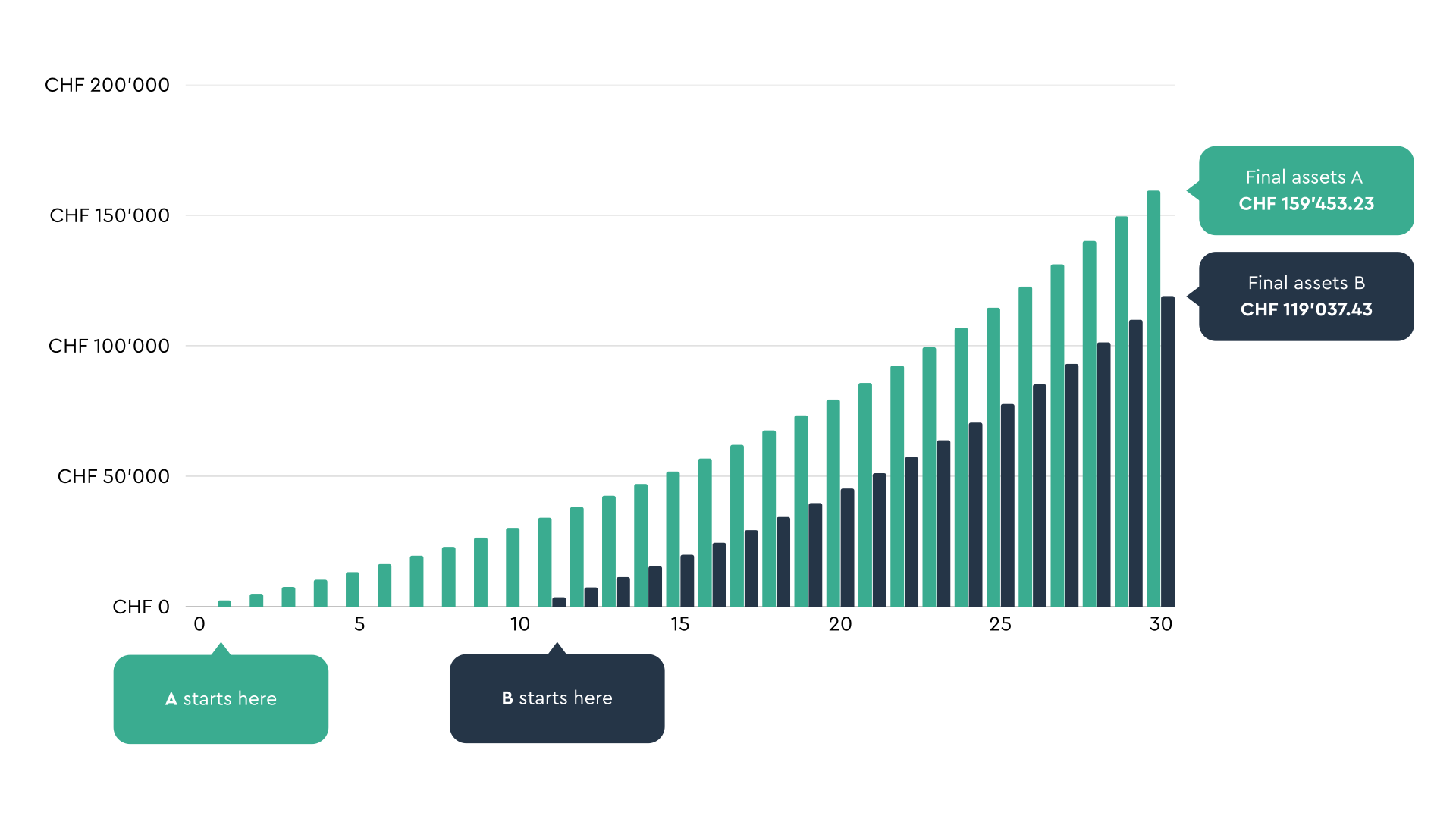
Even though they both deposited the same amount, Person A has a full CHF 40’415.80 more in their portfolio than Person B in the year 2055, simply because the investment horizon is longer.
Invest regularly instead of waiting for the perfect moment
You don’t need to try and time the best moment in the stock market. Anyone who invests regularly buys at different price levels. As a result, you buy more shares when prices are low and fewer when prices are high for the same amount of money. This is called the cost-average effect. You can find more detailed information and example calculations in this article.
This can help reduce the risk of an unfavorable entry point. However, it does not prevent losses nor does it guarantee a higher return.
A monthly standing order can help you invest regularly without having to think about it every time.
Should I wait for a good time to make my investment? Is there even a perfect time to invest?
Simply put: There isn’t, because neither you nor anyone else can see into the future. We calculated exactly this based on historical stock market prices and four hypothetical investors. You can find the detailed article and calculations here.
The conclusion: Being invested is more important than timing the market. Since the differences in returns between a random timing and the ‘perfect’ timing are surprisingly small, starting as early as possible is crucial.
8. When can you withdraw your Pillar 3a funds?
The money in Pillar 3a is tied up. Therefore, you cannot simply withdraw it whenever you need it for a private purchase or a major expense. However, the law provides for various reasons for a payout.
- Upon retirement: Generally, you can draw your balance at the earliest five years before reaching the ordinary AHV reference age. If you continue to generate an income subject to AHV contributions thereafter, you may also postpone the withdrawal bzw. [or defer it]
- For owner-occupied residential property: You are allowed to use your balance for the purchase or construction of your own home or for paying off a mortgage. Buy-ins into your residential property are possible. Did you know that VIAC also offers a mortgage in cooperation with Bank WIR?
- Upon taking up self-employment: If you start an independent business and are no longer compulsorily affiliated with a pension fund, an early withdrawal may be possible. Statutory deadlines and proof requirements apply.
- Upon definitive departure from Switzerland: If you leave Switzerland permanently, you can generally withdraw your Pillar 3a balance. The tax consequences depend, among other things, on your personal situation. You can find which documents you need to close your Pillar 3a following departure from Switzerland [link context]
- In the event of disability: A withdrawal may be possible under certain legal conditions, for example, in the case of a full disability pension and a lack of insurance coverage for the corresponding risk.
9. Pillar 3a when buying a home: Early withdrawal or pledging?
If you want to buy a home, you can use your Pillar 3a balance for it. There are two options for this: early withdrawal and pledging.
Early withdrawal: You withdraw your pension funds
With an early withdrawal, part or all of the balance from your Pillar 3a is paid out. You can use the money, for example, for the equity required when buying a home or to pay off a mortgage.
The advantage: You have more equity and may require a smaller mortgage.
The disadvantage: The money is then missing from your retirement provision. If you sell securities, an unfavorable stock market timing can also reduce the proceeds achieved. Capital withdrawal taxes are also incurred on the amount paid out.
Pledging: Your balance remains in Pillar 3a
With a pledge, you do not withdraw your retirement savings. Instead, it serves your bank as additional collateral for the mortgage. Your money therefore remains in Pillar 3a and can continue to earn interest or be invested. This allows the bank to grant a higher mortgage than it would without the additional collateral.
Pledging can be tax-efficient because no payout occurs during the pledge itself, meaning no capital withdrawal tax is initially triggered. However, you must be able to service the higher mortgage and you continue to bear the investment risk.
Which option is better depends, among other things, on your income, affordability, mortgage interest rate, and investment strategy. Pledging is not automatically cheaper. Have both options calculated for you before making a decision.
10. How can you save taxes with Pillar 3a?
Tax savings start with the contribution. You can deduct your contributions from your taxable income. No wealth or income taxes are levied on the balance during the term either.
Upon payout, the balance is taxed separately from other income at a reduced rate. The amount of tax depends, among other things, on the payout amount, your place of residence, and your marital status.
However, there is a way to reduce the tax burden upon payout: multiple 3a accounts or pension relationships.
Why multiple 3a accounts can make sense
If you withdraw your entire retirement savings in one year, the whole amount is taxed in that year. Because taxation is progressive, the tax rate can be higher when the payout amount is large.
If you distribute your balance across multiple pension relationships, you can withdraw them in different years. This spreads the payouts across multiple tax periods and breaks the tax progression. You can find more information on staggered withdrawals in this article.
In practice, up to five 3a accounts can make sense. Also note that not every provider allows multiple pension relationships to the same extent. With VIAC, you have the option to set up to 5 portfolios, which enables staggered withdrawals to break the tax progression.
Important: When making a withdrawal, the statutory withdrawal requirements must be met. A single 3a account cannot simply be withdrawn in partial amounts at will; it must always be withdrawn in full. Therefore, plan the division early on and clarify the tax consequences for your canton of residence.
What sets VIAC’s Pillar 3a apart?
When choosing your 3a solution, it is worth looking not only at the costs, but also at the return potential, flexibility, and services offered.
With VIAC, you can manage your retirement savings digitally and choose your investment strategy yourself.
Digital and simple: You open your Pillar 3a digitally and manage your pension provision conveniently via the VIAC app or web portal.
Cost-effective: Costs depend on the strategy chosen. At VIAC, total costs are transparently displayed. No administration fee is charged on uninvested account balances. You can find the current fees for individual strategies here.
Flexible investing: You can deposit starting from as little as CHF 1 and choose between an account solution and various securities strategies. Depending on the strategy, up to 99% equities are possible. You can adjust your strategy as needed.
Automatic monitoring: The VIAC Autopilot monitors your portfolio and helps maintain your chosen strategy. You can find more info on the VIAC Autopilot here.
Free basic protection: With VIAC Life Basic, you receive free basic coverage for disability or death. It is calculated based on your invested retirement assets. You can find the exact benefits and conditions here.
Security through strong partners: Your Pillar 3a is managed via the Terzo Pension Foundation of Bank WIR. The legal structure of the pension solution and the treatment of assets in the event of bankruptcy are clearly regulated.
VIAC Deals: As a VIAC client, you get access to exclusive offers and discounts for various products, services, and insurance policies. You can find more info on VIAC Deals here.
11. What is Pillar 3b?
The term Pillar 3b is commonly used for unrestricted private pension provision. Unlike Pillar 3a, it is not a legally defined form of pension provision with a uniform set of rules.
The term is primarily used as an umbrella term for various ways to build up private wealth.
This includes, for example:
- Savings accounts and securities portfolios
- Cash under your mattress and in your piggy bank
- Real estate
- Life insurance policies
- And much more
In contrast to Pillar 3a, money in unrestricted provision is available at any time. However, there are generally no tax advantages like those with Pillar 3a. Whether and how returns are taxed depends on the respective investment form.
If you want to build up wealth in addition to Pillar 3a, a securities portfolio can be a sensible addition. You remain flexible and can use the money for a major purchase, a sabbatical, or your financial independence, for instance.
VIAC Invest is our investment solution for flexible wealth
With VIAC Invest, you can invest starting from CHF 1, manage multiple portfolios for different goals, and determine your investment strategy yourself.
For families, there is also the children’s portfolio, allowing you to invest money for your children over the long term. Find out here why you should definitely invest for your children.
And if you want to withdraw money regularly from your portfolio later on, the withdrawal plan supports you in doing so. This allows you to cost-effectively and efficiently invest the capital withdrawal from your pension fund assets and pay yourself a “personal pension” monthly. The advantage over a pension fund annuity: In the event of death, your assets at VIAC Invest are paid out to your heirs.
12. What happens to my Pillar 3a in the event of death?
If you pass away, your 3a assets do not simply become part of your normal estate. A legally defined order of beneficiaries applies to the payout.
First and foremost, this includes the spouse or registered partner. Depending on the family situation, this is followed by other persons such as children and other legally designated beneficiaries.
A simple explanation of how inheritance law works in Switzerland can be found in this blog article or in these FAQs.
13. How safe is my money in Pillar 3a?
When it comes to the safety of your retirement savings, you must distinguish between account balances and securities.
Account balances: Although money in a Pillar 3a account is not protected by standard deposit insurance, it enjoys a special bankruptcy privilege in the event of bankruptcy of the bank or responsible pension structure. At VIAC, account balances with the Terzo Pension Foundation of Bank WIR are privileged up to CHF 100’000 per foundation within the legally designated bankruptcy class.
Securities: When you invest in funds, the securities generally belong to special assets (segregated assets) and do not fall into the bankruptcy estate of the custodian bank in the event of its bankruptcy. This protects you from losing securities solely due to a bank bankruptcy. However, it does not protect you from market losses on the financial markets.
A securities solution is therefore not risk-free. You should distinguish between the risk of a bank failure and the investment risk. Both aspects are relevant when choosing your strategy.
You can find more on safety in these two FAQ articles.
14. The most common Pillar 3a myths
“I have to pay in every year.”
No. Contributions are voluntary. You can decide every year for yourself whether and how much you want to pay in. However, if you have taken out an insurance solution, contractual obligations may apply.
“I am only allowed to pay in the maximum amount.”
No. You can also pay in less. The upper limit merely determines the maximum amount you can contribute and deduct from taxes each year.
“An account solution is always safer than a securities solution.”
Not in every respect. With an account solution, the balance does not fluctuate with market prices. On the other hand, inflation can reduce the purchasing power of your money. With securities, there are higher return opportunities, but also risks of loss. Which solution fits better depends on your situation.
“I can withdraw my 3a money whenever I need it.”
No. Pillar 3a is tied up. A withdrawal is only possible in legally specified cases, such as upon retirement, purchasing owner-occupied residential property, or leaving Switzerland permanently.
“Pillar 3a is only worth it if I pay in the maximum amount.”
No. Even smaller contributions can add up over many years. The crucial factor is that you save regularly and within your financial means.
“All Pillar 3a providers cost roughly the same.”
No. Costs can vary greatly. Always compare the total costs and not just the stated administration fee. High fees eat into returns and reduce the wealth you can accumulate until retirement.
Conclusion: Start with your private pension provision
Pillar 3a helps you save privately for retirement, save taxes, and build wealth over the long term. You don’t have to contribute the maximum amount right away or every year. What matters most is finding a solution that fits your budget and goals.
Pay attention to costs, select your investment strategy based on your investment horizon, and keep in mind when you will likely need your money.
With VIAC, you can open your Pillar 3a digitally, choose your investment strategy yourself, and manage your retirement provision flexibly. Start your Pillar 3a with VIAC now and take the first step toward your financial future.
Have any more questions? Check out our FAQs or the VIAC Academy.
Didn’t find an answer? Then contact our support! We are here for you from Monday to Friday between 8:30 am and 6:00 pm!
Call us: 0800 80 40 40
Send us an email: support@viac.ch